Carnival Dream: The Ship That Quietly Changed the Cruise Industry?


When the Carnival Dream entered service in September 2009, the cruise press celebrated it as Carnival’s biggest and boldest Fun Ship to date. Sixteen years on, that framing feels like it undersold what the ship actually was. Look closely at the Dream’s original feature list and compare it to what the wider industry has built in the years since, and a picture emerges of a ship that was not just ahead of its time within Carnival’s own fleet but ahead of the industry as a whole. It rarely gets the credit. It should.
You can view our full tour of the Carnival Dream here
THE LINEAGE: FROM DESTINY TO DREAM
A short side note on the history of the Dream-class to start us off. It starts in the mid-1990s with the Carnival Destiny, the line’s first clean-sheet design following the highly successful Fantasy-class. The Destiny was significant not just because of her size but because she established a design language and internal logic that Carnival would carry forward for the better part of two decades. She was the prototype. Her direct sisters, the Carnival Triumph and Carnival Victory, followed using the same core blueprint.
Carnival then took that template and enlarged it, producing the Conquest-class: bigger, with more public space and a more developed onboard offering, but fundamentally recognizable as an evolution of what the Destiny had established. The core layout, the machinery configuration, the structural DNA all carried forward.
What followed was a brief detour. Costa had developed a European-market derivative of the Conquest class, making alterations suited to their passenger demographic, and the resulting vessels became the Concordia-class. In a one-off move, Carnival took delivery of one of those ships, which entered the fleet as the Carnival Splendor. She was never a natural fit. Built to a slightly different specification for a different market, she always sat somewhat apart from the rest of the Carnival lineup.

You can see how she compares in our Carnival Splendor tour here
The Dream class was Carnival returning to their own drawing board. Built again at Fincantieri and retaining the core layout and machinery philosophy of the Conquest lineage, the Dream was nonetheless a significant step forward rather than a simple enlargement. She was larger, she was configured differently in her public spaces, and crucially she introduced features that would go on to define not just the next generation of Carnival ships but the direction of the wider industry.
See how that evolution continued in our Carnival Vista tour here
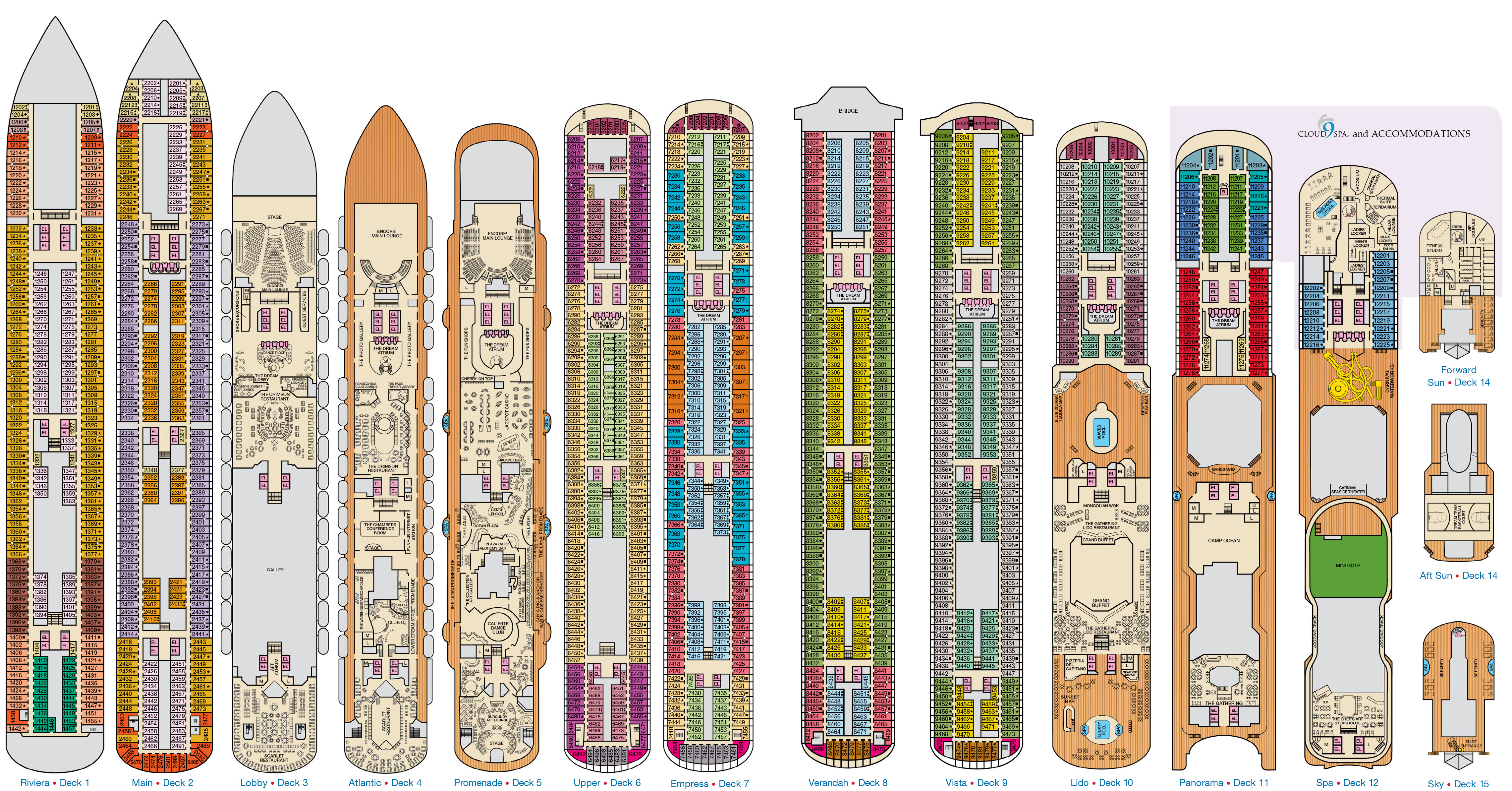
Back to the main article. The most obvious place to start is the Lanai Promenade. At a time when the standard approach to exterior deck space on a large cruise ship meant a narrow walkway high on the hull or a crowded pool deck jostling for sun loungers, the Dream introduced something different: a full wraparound exterior promenade on Deck 5, low on the ship, wide enough to be genuinely usable, and anchored by four cantilevered whirlpools suspended out over the side of the vessel. Attached to it was Ocean Plaza, an indoor/outdoor cafe, bar, and live entertainment venue with a floor-to-ceiling curved glass wall dissolving the boundary between inside and outside. The idea was that passengers could move fluidly between the two, sitting outdoors close to the water or retreating inside without losing the connection to the sea.


Norwegian Cruise Line looked at that concept and understood exactly what it represented. When Norwegian Breakaway debuted in 2013, it introduced what NCL called the Waterfront, a quarter-mile outdoor promenade lined with restaurant and bar venues opening directly onto the exterior of the ship. The concept was refined further on the Getaway and has since become one of the most imitated design ideas in the contemporary cruise industry. The DNA traces directly back to what Carnival put on Deck 5 of the Dream four years earlier.

A CEO CONGRATULATES
As yet another side note (sorry!) On on old episode of CruiseRadio following NCL’s public reveal of The Waterfront, Carnival’s Micky Arison reached out to NCL’s Kevin Sheehan. Arison called to congratulate Sheehan, noting that while Carnival had built the outdoor deck space first, NCL had perfected it by adding the interactive, outward-facing restaurant experience.
The Cove Balconies tell a similar story. Low-position balcony cabins were not entirely without precedent: the Queen Mary 2 had launched in 2004 with balconies positioned relatively low on her hull. But those cabins were conceived as a premium product and sat considerably higher above the waterline than what Carnival introduced on the Dream. The Cove Balconies were genuinely close to the water, giving occupants an experience of the sea that higher balconies simply cannot replicate: the sound of the ocean, the sense of proximity to the surface, a relationship with the water rather than a view of it from a distance. The category has since been adopted broadly across the industry and consistently ranks among the most popular booking choices on ships that offer it.


Then there is WaterWorks. Previous ships had water slides, and Carnival had retrofitted basic slide setups onto earlier vessels, but what the Dream introduced in 2009 was something categorically different: a coherently designed, multi-element aqua park conceived as a destination in its own right, with dedicated space, a full suite of attractions, and an identity of its own rather than an amenity squeezed onto whatever deck space was available. Every major cruise line has since moved in this direction, and the integrated rooftop water park is now as standard a feature on a new cruise ship as a main pool or a show lounge.


And then there is one feature that tends to get overlooked entirely in retrospectives on the Dream: the Fun Hub. Long before reliable shipboard internet, smartphone apps, or the connected cruising experience passengers now take for granted, the Dream launched with what was billed as the cruise industry’s first dedicated onboard intranet portal and social network. Passengers could log on via onboard terminals or early Wi-Fi, build a profile, message other guests, and view digital schedules. It was ahead of where the technology was at the time and perhaps ahead of where the passenger appetite was too, which may explain why it is rarely mentioned today. But as a statement of intent about where onboard connectivity was heading, it was prescient.
None of this is to diminish what came after. Royal Caribbean’s Oasis class redefined scale. Norwegian’s Waterfront refined and commercialized the indoor/outdoor promenade concept with considerable skill. The Cove Balcony category has been improved and expanded by multiple lines. But the Carnival Dream was there first, or close enough to first that the distinction matters, and it achieved all of this at 130,000 gt on a build budget that was a fraction of what its successors cost. It was, in the most practical sense, a ship that worked out what the next decade of cruise design was going to look like and then built it.