You may notice a new look around here. CruiseInd is currently transitioning to an updated theme to improve readability, navigation, and overall performance.

UPDATED ARTICLE: The Residential Cruise Ship Boom—and Bust—Continues

The concept of residential cruise ships—a floating utopia where you can live, work, and play while circumnavigating the globe—is undeniably alluring. Yet, as history has shown, these ambitious projects often sail into stormy waters long before they ever reach the high seas.
Recently, we covered Storylines’ long-promised Narrative, a saga of delays, redesigns, and vanished timelines. And just weeks afterward, two new contenders appeared: Clydebuilt’s Dark Island and Crescent Seas’ Navigator. But in a rapid and surprising shake-up, one of those hopefuls—Crescent Seas—has already dramatically changed course. Let’s break down what’s happening and what it means for the ever-chaotic residential ship sector.
Crescent Seas’ Navigator: The Promising Contender That Just Sank
Originally, Crescent Seas appeared to be the more grounded of the two new ventures. Backed by Russell Galbut—whose real estate and cruise lineage includes founding roles in Prestige Cruises and board leadership at NCLH—the company seemed poised to convert two existing vessels into residential ships: Seven Seas Navigator and Oceania Insignia.

The plan was surprisingly mature. Design work was reportedly complete. NCLH would retain technical management. Navigator would undergo a $50 million conversion, with 210 units priced from $750,000 to $8 million. Some 39 units were already spoken for. Insignia was to follow in 2027.
And then, abruptly, everything changed.
Crescent Seas Terminates Both Charters
According to NCLH’s SEC filing, both long-term charter agreements were terminated before September 30, 2025—barely months after being signed. Crescent Seas conveniently paid a nominal termination fee.
Why the Sudden Shift?
Crescent Seas says its early sales process revealed that high-net-worth buyers wanted larger, more customizable residences than the Navigator or Insignia could physically offer. In response, the company is pivoting entirely to a newbuild, abandoning conversions altogether. Buyers who placed deposits will receive full refunds and priority on the new ship.
What Comes Next?
Crescent Seas now plans to move forward with Ocean, a 55,000-GT newbuild offering more than 200,000 square feet of residential space across roughly 300 units. Delivery is projected for Q4 2031—years later than the original plan to enter service in 2026.

Meanwhile, Navigator and Insignia are staying put:
- Seven Seas Navigator will undergo a major drydock in late 2026 and remain with Regent.
- Insignia will continue sailing with Oceania.
What looked like the strongest new entrant in the residential ship space has effectively reset its timeline by a full decade.
The Dark Island: A Scottish Dream with Slim Chances
Clydebuilt’s Dark Island still appears more like a brochure fantasy than an actual shipbuilding program. The company’s “About Us” page alone raises more questions than answers, and the buzzword-heavy announcements feel designed for investors rather than shipyards.

The vessel’s proposed design also poses serious practical concerns. The extremely high freeboard, with six full decks of balconies before reaching the lifeboat level, far exceeds SOLAS norms. Lifeboats generally cannot be mounted more than 50 feet above the waterline—roughly four passenger decks. (The only major exception in modern times was the Queen Mary 2, which received a carve-out due to North Atlantic service.)
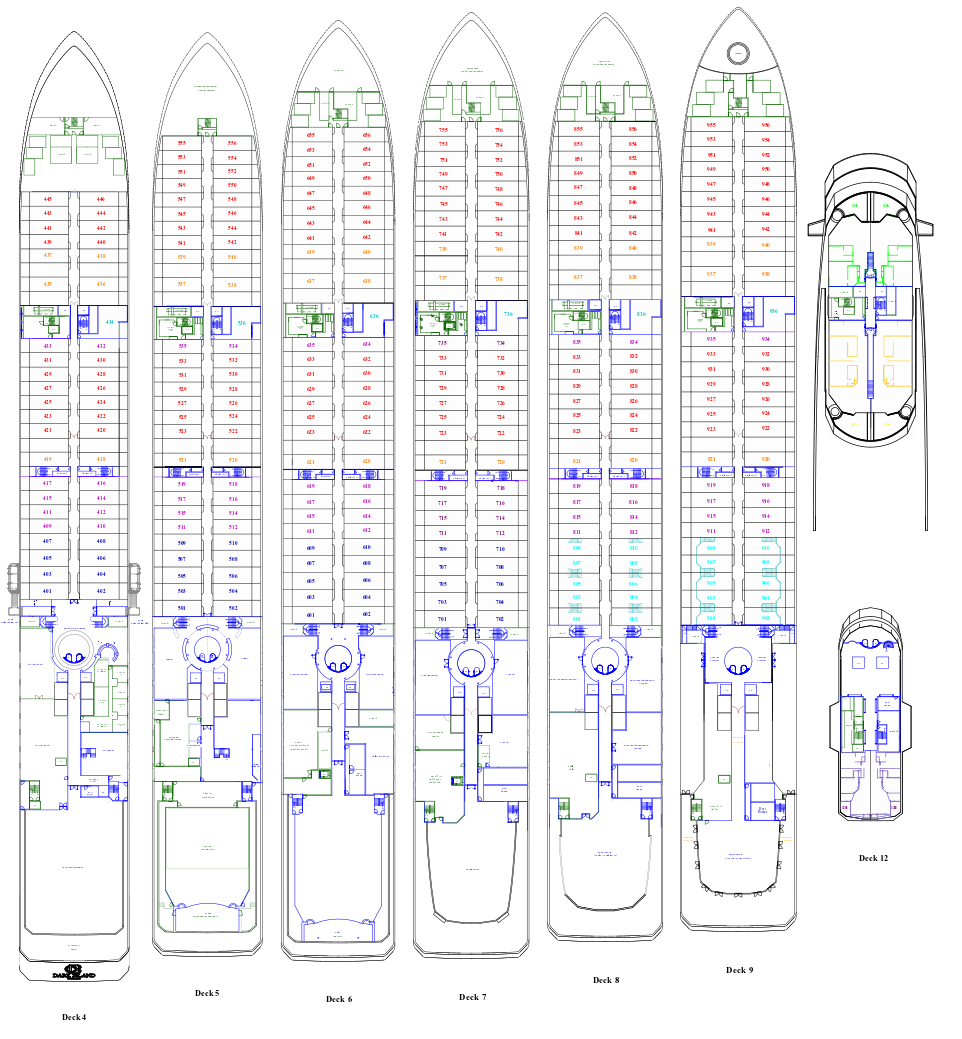
Additional issues emerge from the forward balcony placements, which sit uncomfortably close to the bow flare and low to the waterline. In moderate seas, those balconies would require deadlights and constant maintenance. Deck plans only add to the confusion.


Even so, the Dark Island promises an ultra-luxury offering with 236 residences, a ten-deck atrium, three restaurants, a spa, and even underwater exploration vehicles. But none of that matters if the ship never makes it to steel-cutting—and right now, that feels unlikely.
Villa Vie’s Surprise Move: The Navigator Rumors Return
Just as Crescent Seas stepped away from its ship deals, another player immediately stepped forward: Villa Vie Residences, operator of the Villa Vie Odyssey, the only residential ship currently sailing besides The World.
Villa Vie has announced Project Lumina, a new luxury residential product, and appointed former Crescent Seas executive Chris Cox to lead it. Cox will oversee vessel acquisition, design, sales, and conversions.
While Villa Vie has not confirmed the ship, industry rumors—and the timing—strongly suggest that Seven Seas Navigator is the leading candidate for Project Lumina’s first vessel.
If true, Navigator may be heading straight back into the residential market—just with a different brand and concept behind it.
Lumina promises:
- Fully owned private residences
- High-end amenities
- A curated global itinerary
- An “ultra-luxury villa” residential experience
This would create a two-tier Villa Vie portfolio:
- Odyssey (contemporary, attainable)
- Lumina (luxury, bespoke)
Details are still sparse, but the move signals that the residential cruise segment—despite countless failures—is very much alive.
Residential Ships: A History of Hype and Hard Landings
Only two residential ships have succeeded:
- The World (2002–present)
- Villa Vie Odyssey (2024–present, rebuilt from a 30-year-old cruise ship)
Every other project has either collapsed, stalled, or pivoted:
- Utopia
- Narrative
- Dark Island
- Crescent Seas’ conversions
- Multiple unnamed or short-lived proposals
The challenges are always the same:
- Enormous capital costs
- Small buyer pool
- The tension between luxury design and maritime realities
- Operating complexities far beyond traditional cruising
Final Thoughts
Crescent Seas’ rapid pivot from two ready-made ships to a long-term newbuild underscores how difficult this sector is to enter—even with strong industry pedigree. Meanwhile, Villa Vie’s Lumina project may breathe new life into the concept, particularly if the rumored Navigator acquisition proves true.
As for Dark Island, the concept remains firmly in “believe it when I see it” territory.
Residential ships continue to capture imaginations, but the path to actually launching one remains treacherous. For now, the safest bet is that the vast majority of these plans will remain on paper rather than at sea.


