
The Untold History of Virgin Voyages

The origin story for Virgin Voyages can be distilled to a fairly simple one: a chance meeting in Miami, a code name borrowed from spy fiction, and a British billionaire arriving by helicopter through red smoke. Running alongside it is a signed LoI for two very different ships that never came to be, a pandemic that has derailed the entire initiative on multiple fronts, and a legal dispute from a rival ousted industry CEO that was quietly settled before Virgin Voyages ever carried a paying passenger.

The company’s origin is anecdotally traced to 2011, at the Doral Hotel and Country Club in Miami. Nirmal Saverimuttu, an investment banker who had been leading Virgin Group’s North American development (who had key roles in Virgin America and Virgin Hotels), sat down over beers with Tom McAlpin. McAlpin had previously headed planning at Royal Caribbean and had been part of the founding team behind Disney Cruise Line. At that time he was running The World, the residential condo ship based out of Fort Lauderdale. The two men began sketching out how Virgin might enter the cruise business, continuing their conversations under the internal code name Project Red Sea, referring to each other as Red Sea 1 and Red Sea 2.

Within two years, Saverimuttu was pitching Bain Capital at the John Hancock Tower in Boston. Bain had already been researching the cruise sector on its own and was specifically interested in a line built from scratch around new, higher margin ships paired with an established consumer brand, which was exactly what Virgin offered. Finally, Bain signed on as lead investor and were joined by additional investors. In total, the group raised roughly $700 million in equity, supplemented by an estimated $1 billion in borrowed capital.

Alongside that story runs a separate one involving a different vision for what Virgin’s cruise line might have looked like, one that played out largely in a Miami courtroom rather than in epic press events.
[STOPPED EDITING HERE]
A COUNTER-NARRATIVE: A DEEP DIVE

Colin Veitch was CEO of Norwegian Cruise Line from 2000 to 2008. During his tenure he both pioneered Freestyle Cruising while also spearheading the controversial plans behind the Norwegian Epic, an early example of what the industry calls an ultra-ship: a very large vessel built around unique attractions that command higher fares and drive substantially greater onboard spend, generating, by Veitch’s own estimate, roughly 60 percent more profit than a conventional ship of similar size. According to a complaint he later filed in federal court, after leaving Norwegian in late 2008, Veitch approached Virgin in early 2011 with a plan for two of these ultra ships.
Veitch alleged that the original arrangement had Virgin licensing its name to a new cruise line while his own company, VSM Development, would be a partner in owning and operating it, with Veitch himself serving as CEO and receiving 90 percent of profits not otherwise guaranteed to investors per the complaint. His filing claimed he had supplied Virgin with a fully formed cruise line business plan, secured an investment bank for financing, arranged a management team, and reached agreement with a shipyard.
That shipyard agreement is where things get interesting in a ‘alternate reality’ type scenario. According to the filing in early 2012 Veitch’s VSM Development and Virgin Group Investments jointly signed a letter of intent with Germany’s Meyer Werft shipyard. Veitch had previously had experience there as they had built NCL’s Jewel-class ships during Veitch’s time as CEO so it seemed like a natural fit. The intent was to construct two 173,000 gross ton vessels carrying 4,650 lower berths each, at a price of €830 million each, with deliveries as early as 2015 and financing already arranged through a German export bank. By that point Veitch had also brought on ship designers including SMC Design and Foreship Oy. The stated strategic logic behind the ultra ship approach was that a startup line launching with only large, high-margin ships would carry none of the older, less profitable tonnage that weighed down its established competitors, allowing it to move directly to the fleet economics that Norwegian’s Epic and Royal Caribbean’s Oasis of the Seas had already demonstrated.
The relationship between Veitch and Virgin changed within weeks of that letter of intent. According to Veitch, in early 2012 Virgin proposed a new term sheet seeking 60 percent of the profit share instead of the 10 percent originally discussed with Veitch remaining on as CEO under Virgin’s brand. The two sides did not reach agreement on the revised structure, and the Meyer Werft order was never converted into a binding shipbuilding contract. According to Veitch’s complaint, his involvement in the project ended by summer 2012, around the time Virgin brought in Tom McAlpin to lead the effort. It’s important to keep in mind that Virgin’s own account of this period has not been made public in comparable detail. Virgin’s public response pointed to a different and much longer timeline, stating that Richard Branson and Virgin Group had first looked at the cruise market as far back as the late 1970s.
Veitch filed suit in federal court in Miami on March 11, 2015, seeking $300 million that he felt he was owed under that initial agreement. That suit is the source for this detour in our narrative. That case was resolved on January 25, 2016, when both parties filed ‘notice of a confidential settlement.’
With that legal matter proceeding separately and not derailing the initiative, the publicly known Virgin Cruises project moved forward on its own track. The company was formally announced on December 4, 2014, in New York, with McAlpin named CEO and Bain Capital confirmed as lead investment partner, headquartered in Fort Lauderdale. At launch the entire company consisted of three employees: McAlpin, Saverimuttu as chief commercial officer, and chief marketing officer Nathan Rosenberg, with former Virgin Atlantic design lead Dee Cooper under contract as an early fourth voice on the creative side.

The most consequential early decision came from consumer research. As mentioned above, the original plans called for two 173,000gt ships carrying roughly 4,500 passengers each. Focus groups run in Chicago, New York, and Florida through late 2014 and early 2015 showed that Virgin’s target customers were wary of mega-ships. In response, Virgin shrank the planned ship size by roughly a third and grew the planned fleet by the same margin, moving from two large ships to three smaller ones of about 2,800 passengers apiece. The change forced a complete rewrite of the general arrangement plan, reportedly completed in six weeks, partly under pressure to lock in weekend berthing slots at PortMiami before they were gone.
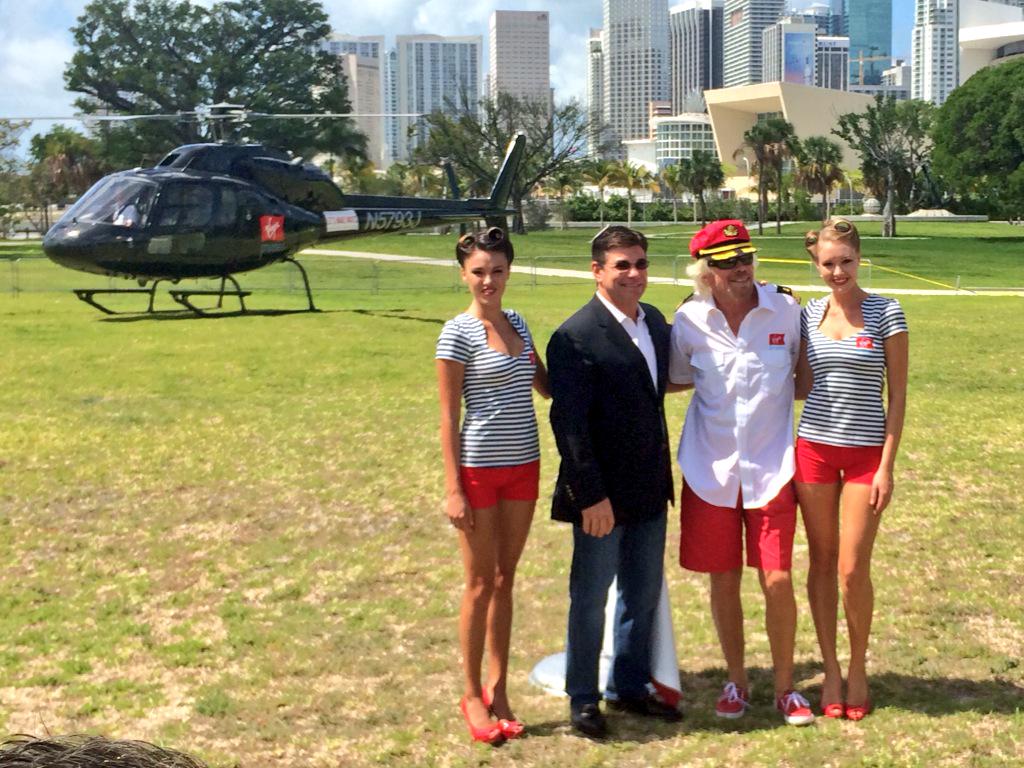
The company went public with its plans on June 23, 2015, when Branson arrived at Miami’s Museum Park by helicopter through red smoke, wearing a red captain’s hat and red shorts, and raised the Virgin Cruises flag alongside McAlpin. The event confirmed Miami as homeport and Fincantieri as the shipbuilder, along with the three ship, 2,800 passenger plan.
The company took its current name a year later, at an event at a Miami Beach hotel in October 2016, when Branson revealed the Virgin Voyages identity and simultaneously announced a signed shipbuilding contract with Fincantieri for three vessels. Branson offered the line that would become the company’s defining piece of branding logic: he had never fancied going on a cruise ship, but he did fancy going on a voyage.

Construction proceeded at Fincantieri’s Sestri Ponente yard near Genoa. All four eventual sisters were built to the same specification: 110,000 gt, 909ft LOA, with capacity for 2,770 passengers and 1,160 crew. She’d be powered by four Wärtsilä diesel generators producing 48,000 kilowatts combined, driving two 16,000 kilowatt ABB Azipod units for a service speed of 20 knots. Scarlet Lady, the first of the class, had her first steel cut in March 2017 and her keel formally laid on October 31 of that year. She was assembled from 399 individual blocks and floated out on February 8, 2019, before running Mediterranean sea trials between Genoa and Marseille that November. Her name honors G-VRED, Virgin Atlantic’s second aircraft, an Airbus A340-600, tying the ship to the same aviation heritage that runs through Virgin’s naming conventions across its businesses. Fincantieri delivered her on February 14, 2020, Valentine’s Day, a fitting detail at the time that would soon take on a very different significance.
Scarlet Lady departed for Dover immediately after delivery, calling at Dover and Liverpool in late February 2020 to host travel advisors, media/influencers, and VIP guests ahead of her planned crossing to PortMiami, where two preview sailings were scheduled for late March before an April 1 maiden voyage.
None of it happened.
It’s hard to imagine that the COVID-19 pandemic started over six years ago. Planned preview events in New York were subsequently cancelled and the ship rerouted directly to Miami, where her christening, set for March 19, 2020, was postponed indefinitely as the CDC’s No Sail Order brought the entire industry to a halt before Scarlet Lady had ever carried a single paying passenger.

What followed was a situation genuinely unique among Virgin’s competitors. Every other cruise line laying up ships during the pandemic was mothballing vessels that had already been earning revenue for years. Virgin found itself laying up a fleet that had never operated at all. Scarlet Lady spent her layup shifting between PortMiami and an anchorage in the Bahamas, a brand new ship with a skeleton crew and zero completed commercial sailings to her name. Her planned maiden voyage slipped first from April to August 7, 2020, then again to October 15, with McAlpin acknowledging publicly that the company had worked hard to sail by August but that it had not proven possible, while stressing that Bain Capital fully supported the delays and the company had sufficient financial resources to weather them.
Her sister ship, Valiant Lady, was completing construction at the same time under pandemic conditions at the same yard. Her keel had been laid on February 8, 2019, she was floated out on May 20, 2020, in the middle of lockdown, and she was ultimately delivered on July 1, 2021, before spending eight further months in her own layup ahead of a March 18, 2022 maiden voyage. Both of Virgin’s first two ships share the unusual distinction of sitting idle for months on end before ever earning a dollar of revenue, a circumstance shaped entirely by the pandemic rather than by anything specific to the company.
When Scarlet Lady finally did enter service, it was not from Miami at all. Her actual first passenger voyage departed Portsmouth, England on August 6, 2021, as part of a UK summer season, followed by her intended homecoming voyage from Miami on October 6, 2021, a full eighteen months after her original April 1, 2020 start date. Valiant Lady followed an almost identical script, opening with a three night Portsmouth to Zeebrugge run and a UK season running through May 2022 before repositioning to Barcelona for the Mediterranean summer. She never received a traditional naming ceremony. Instead, Jennifer Lopez, also an investor in the company and its chief entertainment and lifestyle officer, served as her godmother under what Virgin describes as a modern, change-making partnership model rather than a conventional christening.
That is where this part of the story ends, with two ships finally at sea roughly a year and a half behind their original schedule. What began with a conversation at a Miami hotel, ran through a legal dispute that was resolved privately, and was then delayed by a global pandemic, eventually became one of the more closely watched new entrants in modern cruising. How the company built out the rest of its fleet, and where it stands today, is a story for another time.


